So, I made the “Seals on the Bus” flannelboard from Making Learning Fun and tried to photo-document my process so that I could theoretically teach others how to make the same flannelboard.
Obviously, an image intense entry, sorry slow browsers!
The “Seals” template had great instructions for the bus template, so I seriously just followed their directions.

I made two wheels, six windows, and cut a large piece of felt for the bus. (The pattern said to extend the middle of the bus 18″, but that was much too large for my flannelboard, so I only extended the bus 8″.) In the picture you can still see that the bus template is taped onto the yellow felt, which is how I know where to cut without marking the felt.
Next up, the characters:

What I did here was separate the characters into different levels of details. For the left group (snake, monkey, seal, and goose), I have a base layer and maybe one or two details. For the right group (bunny, sheep, skunk), there will be a lot of layering/detailing. And for the top group (tiger, girl, boy), there will again be a lot of layering/detailing, but a different kind. I’ll try to break down each group and my thoughts as I go.
For me, the easiest way to make a flannelboard character is to literally copy the template. I follow the following steps:
1. Print out the template and cut it out.
2. Tape the template to the felt.
3. Cut out the main piece.
4. Cut out the details from the template; largest to smallest!
5. Tape the detail templates to the felt and cut.
6. Glue layers/decorations.
7. Add eyes and paint.
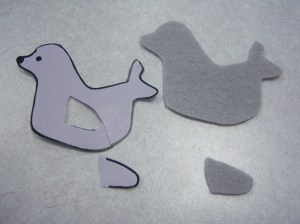
So, for the seal, I just cut out the main piece first. Then, I cut out his flipper, and taped that to a felt scrap to make a felt flipper. To put together the seal, I put the template (with the flipper missing) on top of the felt seal, added a drop of Tacky Glue and placed the felt flipper where it belonged. Pretty simple!
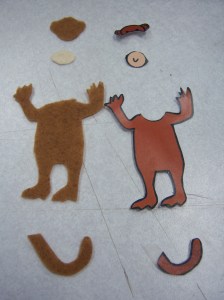
And for the monkey, I cut out a large body piece using the whole template. Then, I cut off his head and cut a head out of brown felt. Then, I cut the template again and got a peach colored snout for the monkey. Finally, I cut off his tail and made a longer felt tail to attach to the back of the piece for some dimension.
Always start cutting out the biggest piece first and trim your template down from there. Don’t make the smallest pieces first, or you’ll wind up printing out multiple templates.
Now, for the second grouping, I’m going to use the bunny as my example.
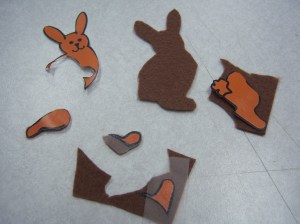
Okay, so this picture gives you an idea on how I actually make the different pieces. Sometimes I use tape on the back of a template to adhere the template to the felt. Sometimes, I use a piece of tape over the template directly on the felt.
It also shows how I have a main piece that I add layers to. The front layers (the closer foot and arm) will be glued on top of the bunny while the back layers (the farther foot and arm) will be glued to the back of the bunny. If you’re gluing to the back of a piece, always make sure to leave some extra felt attached to the shape so that you can glue it without gluing anything together by the edges. (You can see in the picture the back arm has an extra bit of brown felt sticking past the template for gluing!)
For the third grouping, the people — start with the base/skin color and cut the whole template out. (Orange for tiger, peach for people.) Then, simply add the clothing in layers and trim the base/skin color so that it doesn’t show around the clothing. I didn’t take pictures of this because a) I was on the desk after-school while making this and b) it’s pretty straightforward.
But a finished product photo of all three: tiger, girl, boy:

Now, for painting and wiggly eye gluing.

So, painting. I just use a smidge of tempura paint. And yes, that IS a paper clip in the paint! It is way easier than using a brush (which is hard to control for small, concentrated areas like eyes) and I kind of hook my finger into the curve of the paper clip which helps me keep a steady hand.
A giant felt painting tip — don’t drag anything across the felt! You will actually pick up felt fibers which can and will smear your paint job. When I paint, I just get a little of the tip of paper clip and poke the felt. (So, for an eye one poke will do, but for the tiger’s stripes, I had to poke it several times to get the shape I wanted.)

Painting is the most stressful part for me, and I have had to remake a piece because I dribbled paint where I didn’t want it. (On the other hand, I’m a perfectionist and maybe the paint dribble wouldn’t have bothered you!)
Lastly, I attached wiggly eyes to some of the pieces. (Always for human characters, and occasionally for animal characters — the like the skunk, which I couldn’t paint black eyes on a black body.)
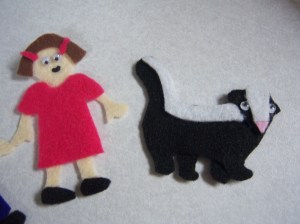
(I’d be wary too, little girl, with a skunk so close!)
Anyway, I hope this long and drawn-out post has given you some insight/ideas on how to make your own flannelboards. If you have questions, you can always feel free to leave a comment and I’ll do my best to try and find an answer/give advice!
I leave you with a final look at the newest flannelboard at my library:






 storytime katie